
VIKTOR REINHARDT
Wisconsin Regional Primate Research Center
ABSTRACT. Eight single-caged adult rhesus macaques were given the choice of freely collecting their standard food ration, i.e. 33 biscuits, from an ordinary food box or working for its retrieval from a custom- made food puzzle. During a one-hour observation session following the simultaneous distribution of biscuits in both feeders, individuals spent on average a total of 32 sec retrieving 29.0 biscuits from the food box, and 673 sec retrieving 11.3 biscuits from the food puzzle. It was inferred that the animals voluntarily worked for ordinary food, with the expression of foraging activities serving as its own reward.
Key Words: Macaques; Foraging; Environmental enrichment.
INTRODUCTION
It is generally agreed that caged nonhuman primates receive too little opportunity to forage. In response to recent federal animal welfare rules proposing task-oriented feeding methods as a means of environmental enrichment (USDA, 1991), a great variety of foraging devices have been developed (review: REINHARDT & REINHARDT, 1992). Most of them are supplemental feeders baited with favored food items rather than ordinary food. This suggests that the animals are reluctant to work for food unless it is especially attractive.
Rats and pigeons will readily press a lever and peck a disk, respectively, to get access to food while identical food is freely available (JENSEN, 1963; NEURINGER, 1969; OSBORNE, 1978). Stump-tailed macaques will search through woodchips for grain even if grain is available without any need for searching (ANDERSON & CHAMOVE, 1984). Chimpanzees will sometimes attempt to solve a discrimination problem for food rather than simply taking freely accessible food (MENZEL, 1991). These observations suggest that working for the acquisition of food may be a rewarding experience on its own.
The present study tests this hypothesis in caged rhesus macaques that were given the choice to freely gather their standard ration of biscuits or to work for its retrieval.
MATERIALS AND METHODS
The subjects were eight healthy, 6-yr-old male rhesus macaques (Macaca mulatta) housed as four compatible pairs in 70 cm deep, 150 cm wide, and 77 cm high lower-row double cages. Room temperature was maintained at 20-22ºC, with a relative air humidity of approximately 50% and a 12-h light/dark cycle.
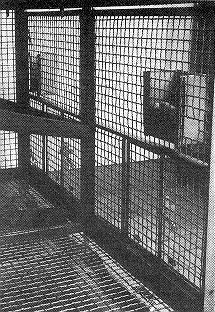
Each cage was equipped with two perches, two gnawing sticks, two drinking spouts, and two food puzzles. The puzzles consisted of ordinary food boxes re-mounted on the mesh at the far sides of the cage front in such a manner that they no longer covered the access holes. This arrangement hindered the animals from simply reaching inside the box. Skillful manipulation with the fingers through the 22 x 22 sq. mm mesh was required to retrieve the food (Fig. 1). The biscuits were bar-shaped, measuring approximately 40 x 24 x 16 mm. Each pair was fed a standard ration of 66 biscuits equally distributed in the two food puzzles, daily at 09:00 a.m. for a period of four months. The food puzzles were the only source of biscuits during this time, and the animals completely retrieved their rations every day.

Paired partners were temporarily separated from each other (maintaining visual contact) for this study to allow assessment of individual feeding behavior. Experimental subjects were singly housed in their home cages with one of the two food puzzles being replaced by an equal-sized food box (14 cm wide, 7 cm deep, 17 cm high) mounted at equal height (40 cm off the cage floor) over a 73 x 73 mm access hole (Fig. 2). The distance between the food puzzle (in one half of the cage) and the food box (in other half of the cage) was 110 cm (Fig. 2). Each container was filled simultaneously at 09:00 a.m. with 33 biscuits. Subjects were habituated to this feeding regimen for one week; their feeding activities were observed on day 7 from 09:00 to 10:00 a.m. The animals were well familiarized with the author who recorded the following parameters while sitting at a distance of approximately 2 m from the center of the home cages. 1) Number of biscuits retrieved: a) from the food box, by reaching for them through the access hole; this may be accompanied by fingering several pieces before choosing one for retrieval; b) from the food puzzle, by maneuvering biscuits with the fingers into appropriate positions behind the mesh, pushing biscuits with the fingers through the mesh, pulling biscuits with the fingers and/or teeth through the mesh, breaking protruding parts of biscuits with the teeth. 2) Number and percentage of retrieved biscuits consumed: biscuits and pieces of them were counted as being consumed once they were ingested. 3) Total time spent retrieving biscuits from either of the two food containers. This did not include the time spent eating (masticating, filling/emptying cheek pouches, and swallowing).
RESULTS
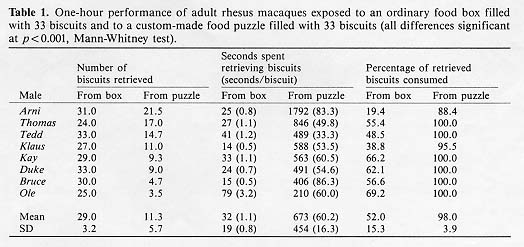
All eight rhesus macaques promptly collected 4 to 12 biscuits from the food box, where they spent an average of 3.5 min before turning their attention to the food puzzle. They worked for biscuits at the puzzle, but soon returned to the box to quickly gather some freely accessible biscuits. This sequence of action was repeated on average 3.8 times (range: 2 to 7 times) during the one-hour observation. On average, individuals retrieved 29.0 biscuits from the food box, and 11.3 biscuits from the food puzzle. Mean total time engaged in retrieving the biscuits was 32 sec (1.1 sec/biscuit) at the food box, and 673 sec (60.2 sec/ biscuit) at the food puzzle (Table 1).
Subjects consumed an average of 26.2 biscuits (range 21.0 to 30.7) of which 15.1 originated from the food box, and 11.1 from the food puzzle. When feeding from the food box, the animals were rather careless and dropped many biscuits on the floor. As a consequence, they consumed only 52.0% of biscuits retrieved, leaving 48.0% as leftover. When feeding from the food puzzle, the animals were more concentrated. They focused their dexterity on the retrieval of one biscuit at a time which they immediately consumed in 98.0% of cases, and dropped on the floor in only 2.0% of cases (Table 1).
DISCUSSION
The rhesus macaques of this study consumed fewer biscuits than were available in each of the two feeders. This gave them the option of procuring all biscuits they intended to consume with minimal effort from the food box. Being eager to get the first food of the day, they started collecting biscuits from the food box. Their attention, however, was soon diverted to the food puzzle where they readily invested a 55-fold increase in foraging time per biscuit despite the fact that freely accessible biscuits were still available in the food box and other biscuits were lying on the floor. It can be inferred from this, that having satisfied their initial appetite, the animals willingly worked for their food, with the expression of skillful foraging activities serving as motivational reward.
The present findings lead to the conclusion that caged rhesus macaques will voluntarily work for ordinary food if given the opportunity to do so. Using foraging devices as primary feeders of standard food rather than as supplemental feeders of special food may be the most cost-effective way of promoting foraging behavior in laboratory nonhuman primates (REINHARDT, 1993).
Acknowledgments
I am very thankful to ELVA MATHIESEN, TAMI WOLDEN-HANSEN, DAN HOUSER, CHRIS NYWALL, and my wife ANNIE for their constructive comments on this manuscript. Supported by USPHS, NIH grant RR-00167 to the Wisconsin Regional Primate Research Center; publication No. 33-009 WRRPRC.
REFERENCES
ANDERSON, J. R. & A. S. CHAMOVE, 1984. Allowing captive primates to forage. In: Standards in Laboratory Animal Science, Symposium Proceedings, Vol. 2, Universities Federation for Animal Welfare, Potters Bar, pp. 253-256.
JENSEN, G. D., 1963. Preference for bar pressing over "freeloading" as a function of number of rewarded presses. J Exper. Psychol., 65: 451-454.
MENZEL, E. W., 1991. Chimpanzees (Pan trogiodytes): problem seeking versus the bird-in-hand, least-effort strategy. Primates, 32: 497-508.
NEURINGER, A. J., 1969. Animals respond for food in the presence of free food. Science, 166: 399- 401.
OSBORNE, S. R., 1978. A note on the acquisition of responding for food in the presence of free food. Anim. Learn. Behav., 6: 368 - 369.
REINHARDT, V., 1993. Enticing nonhuman primates to forage for their standard biscuit ration. Zoo Biol., 12: 307-312.
REINHARDT, V. & A. REINHARDT, 1992. Quantitatively tested environmental enrichment options for singly caged nonhuman primates: a review. Humane Innov. Altern., 6: 374-384.
U. S. DEPARTMENT OF AGRICULTURE, 1991. Animal welfare, standards, final rule. Fed. Reg., 56: 6426 -6505.
Received: March 10, 1993; Accepted: August 12, 1993
This article originally appeared in Primates 35, 95-98, 1994.
Reprinted with permission of the Editor.