

AWI works to influence policies and welfare standards that govern the way animals are treated during each phase of production. Welfare concerns vary based on species. Information about specific welfare issues associated with commonly farmed animal species is provided below.
Dairy Cows
According to the US Department of Agriculture, approximately 9.4 million dairy cows were used for milk production in 2023. Although all cows are grazing animals, inclined to live together in herds and range grasslands, most dairy cows today live within concentrated animal feeding operations (CAFOs)—aka factory farms—in barren dry lots or “freestall” barns where they have little or no outside access or opportunity for exercise.
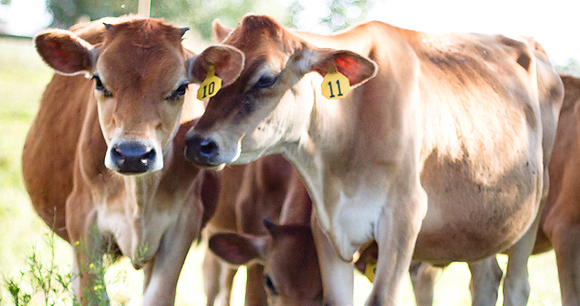
Today’s dairy cow has been genetically selected to produce up to 12 times the amount of milk needed to feed her calf. Producers have maximized productivity, but the cows unquestionably suffer poor welfare as a result. In traditional pastoral conditions, before industrial farming, cows could live up to 20 years; today’s dairy cows are normally sent to slaughter before they are 6. Throughout their short lives, many cows suffer from lameness and other painful conditions that are consequences of poor handling and breeding practices in industrial systems.
Producing such vast quantities of milk in one lactation cycle is so taxing and stressful that dairy cows are typically kept for about four or five years (three cycles of pregnancy, birth, and lactation) before they are slaughtered. By the time they are deemed ready for slaughter, they are often in poor physical condition. Frequently, they are then subjected to long, difficult journeys to slaughter facilities—further prolonging their suffering.
Higher-welfare, pasture-based dairy farming represents a significant improvement for cow welfare.
Dairy Calves
In order for a dairy cow to produce milk, she must give birth to a calf. Soon after birth, most calves are removed from their mothers and transported off the farm. A portion of the female calves (referred to as “replacement heifers”) are reared off site by specialized operations until they are ready to give birth and produce milk. The remainder, as well as the males, are “surplus.” Some are raised for veal and slaughtered early. Others become “fed dairy” beef and are slaughtered at around 1 year of age. An increasing number of producers have begun cross breeding dairy and beef cattle to produce more valuable “beef on dairy” calves, which currently account for around 20 percent of US beef production.
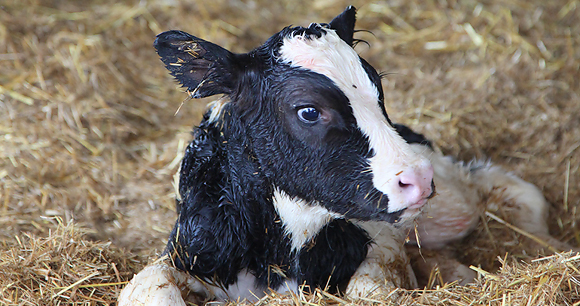
The approximately 300,000 veal calves and 4.7 million “fed dairy” calves raised in the United States each year have no interaction with their mothers and more limited physical activity than a typical calf raised for beef. Unlike calves raised for beef, most veal calves are housed indoors. Until recently, most calves raised for veal were confined in small, solitary stalls for 16 to 18 weeks until slaughter. In 2017, the veal industry completed its voluntary phase-out of “veal crates,” although some producers may continue to confine their animals in this manner. Some veal calves are fed only a compromised liquid diet and are purposefully kept anemic and weak in order to yield tender, pale meat. Most “fed dairy” calves spend their first 9–10 weeks individually housed in tiny plastic or wooden hutches or narrow wooden stalls. Afterwards, they are raised in groups until they are slaughtered around 1 year of age.
Because veal calves are removed from their mothers and slaughtered at a very young age, some higher-welfare certification programs do not certify any veal—reasoning that “high-welfare” veal is simply not possible to produce. The production of “fed dairy beef” also involves significant welfare issues, as calves not only are initially housed individually with minimal space but also are often subjected to long-distance transport at a very young age.
Beef Cattle
Nearly 32.8 million cattle were raised for meat in the United States in 2023, according to the USDA.
Cattle raised for meat are usually on range for their first 6–7 months of life. This initial ability to walk around, socialize, and eat the food most readily digestible for cows means that these animals start off with better lives than many other farmed animals, such as pigs, chickens, and dairy cows. However, conventional beef cattle systems also incorporate painful mutilations such as castration, dehorning/disbudding, and branding, all without any medical relief for the pain. Even tail docking, typically associated primarily with dairy farms, may be performed when cattle raised for meat spend their early months in cramped indoor barns rather than on the range.
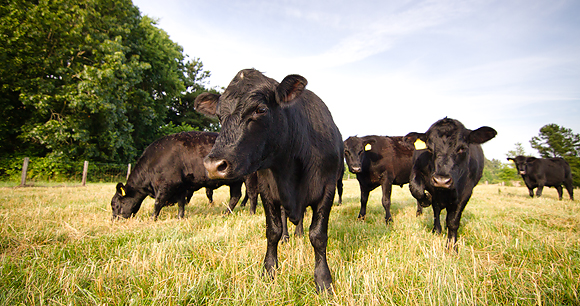
Whether cattle raised for meat start their lives on the range or inside a barn, however, they end up on a feedlot for their last six months before being sent to slaughter. At the feedlot, cattle are confined together in dirty conditions, standing on unnatural slatted concrete floors or in muddy “dry lots” free of vegetation. They are fattened on grain, which causes internal stress and disease because cattle stomachs have evolved to digest forage (i.e., grasses) and are poorly adapted to digest the grains and concentrates (e.g., corn) that producers use to fatten them more quickly.
Higher-welfare, pasture-based farms allow cattle raised for meat to graze and stay in their bonded groups throughout their lives. They spend most of their time outdoors and are allowed to express natural behaviors and eat the food they are adapted to eating and in the manner they prefer—by grazing.
Sheep and Goats
Most of the world’s more than 2 billion sheep and goats are grazed on range in countries such as China, India, and Australia. At the start of 2024, there were approximately 5 million sheep and 2.5 million goats on farms in the United States, according to the USDA. Some operations in the United States raise sheep and goats in intensive conditions similar to those experienced by other farmed animals.
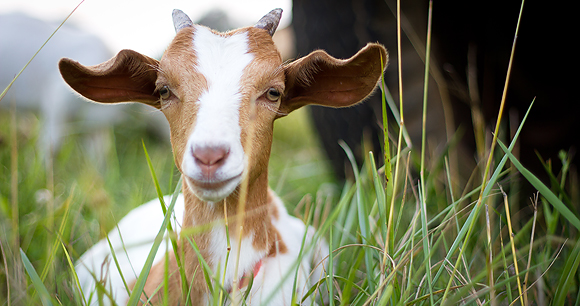
The vast majority of sheep undergo tail docking and castration without pain relief. More extreme mutilations, not widely practiced in the United States, include “mulesing”—the slicing off of whole patches of skin around the tail area—and “short docking,” in which so much of the tail is removed that the animals are unable to cover their genitals and may even suffer rectal prolapses if the procedure damages rectal muscles and nerves. Goats are also routinely subjected to painful dehorning and castration.
On higher-welfare, pasture-based sheep and goat farms, dehorning and tail docking are prohibited, and castration is only permitted when uncontrolled breeding cannot be prevented by any other form of management. Dehorning should be prohibited on goat farms.
Pigs
A majority of the 128 million pigs raised in the United States for meat are housed indoors in barren, cramped factory farms and are subjected to mutilations such as tail docking and castration, both without pain medication. Pregnant sows are traditionally confined to crates for their four-month-long gestation; while in the crates, these sows can only stand in place or lie down facing one direction. Along with the severely restricted movement, they are deprived of any mental and physical stimulation.
Shortly before giving birth, the sows are transferred to another type of enclosure: farrowing crates. As well as being intensively restrictive, these crates limit physical interactions between the sow and her piglets except for suckling. After the piglets are weaned, the sows are again impregnated and subjected to the same treatment, creating a cruel cycle of stress and deprivation until they are slaughtered.
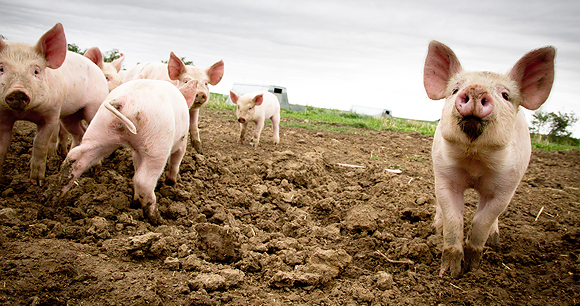
Pigs raised on higher-welfare, pasture-based farms, on the other hand, do not suffer from the welfare problems of factory farms. Pregnant sows remain in groups and are able to build nests when they are ready to give birth. Piglets get to stay with their mothers longer. Because the pigs have space and continuous access to the outdoors, tail docking is unnecessary (and, in fact, is prohibited by higher-welfare certification programs). The pigs have the space and environment that allows them to engage in other natural behaviors, including roaming, rooting, playing, and wallowing.
Egg-Laying Hens
As of September 2024, about 58 percent of the over 307 million egg-laying hens in the United States were confined to barren battery cages where they are crowded and deprived of the ability to perform natural behaviors such as exploring, nesting, perching, dust bathing, or simply stretching their wings. Birds endure painful beak trimming, stand on wire floors that cripple their legs, breathe toxic air, and spend their entire lives under unnatural, dim lighting.
In spite of the appalling conditions, profit and productivity for the industry remains high because the hens have been genetically selected to produce an excess of eggs—at the expense of their own health and welfare.
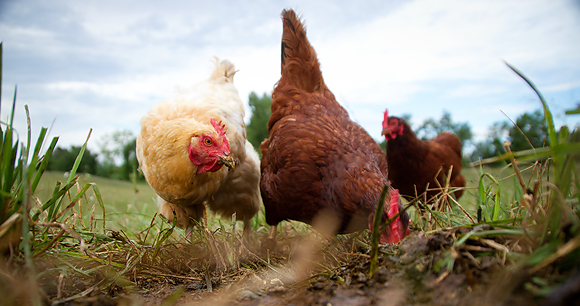
Higher-welfare, pasture-based farms represent a dramatic welfare improvement for egg-laying chickens. Birds on pasture have access to forage, dust baths, fresh air, and sunlight. They can run, fly, stretch, and flap their wings. For laying, they have space to themselves and access to protected nest boxes. Beak (or other) mutilations are prohibited.
Meat Chickens
According to the USDA, over 9.5 billion chickens were slaughtered for meat in the United States in 2023.
Industrial meat chicken farms confine birds inside massive, windowless sheds. They are packed tightly together with as little as 100 square inches of space, in accordance with industry guidelines developed by the National Chicken Council. (The birds would need 138 square inches to spread just one wing.) Industrial farms may house up to 50,000 birds in one building. This extreme overcrowding prevents chickens from performing natural behaviors such as pecking, preening, or even walking around without stepping on other birds.
High levels of ammonia in the litter contribute to extremely poor air quality and painful irritations to the chickens’ feet. Lighting is intentionally kept low to minimize aggression and activity, so birds gain weight more rapidly. An especially serious welfare problem is that the birds are genetically selected to grow at such an abnormally fast rate that their bodies cannot keep up. Their bones break and organs rupture as chickens reach market weight in just six or seven weeks. Some die of heart failure before that.
Higher-welfare, pasture-based farms represent a dramatic improvement in the welfare of chickens raised for meat. They raise chickens who mature at a normal rate, in modest-sized flocks. Birds on pasture can run, fly, stretch, and flap their wings and have access to forage, dust baths, fresh air, and sunlight.
Turkeys
Approximately 218 million turkeys were raised for meat in 2023 in the United States, according to the USDA.
Turkeys suffer welfare problems similar to those experienced by chickens raised for meat. Industrial turkey farms confine birds inside huge sheds that are often windowless and artificially ventilated. Large industrial operations can house 10,000 birds in one building. The birds are packed tightly together with only about 2.5 square feet for females and 4 square feet for males. It is standard practice to perform painful mutilations such as beak, toe, and snood (part of the waddle) removal to prevent turkeys from injuring or cannibalizing each other in the intensely crowded quarters. High mortality rates are common; millions of turkeys die on the farm before they can be sent to slaughter.
High levels of ammonia contribute to very poor air quality and painful irritations to the turkeys’ feet. Lighting is intentionally kept low to minimize aggression and activity so that the birds will gain weight more rapidly. An especially serious welfare problem is that the turkeys are genetically selected to grow at such an abnormally fast rate that their bodies cannot keep up. Turkeys grow so big they are unable to mate naturally; the industry must use artificial insemination to breed them. This is true despite the fact that turkeys selected for breeding have their feed rationed, leaving them perpetually hungry, just to inhibit the rapid weight gain programmed into their genes and keep them alive longer.
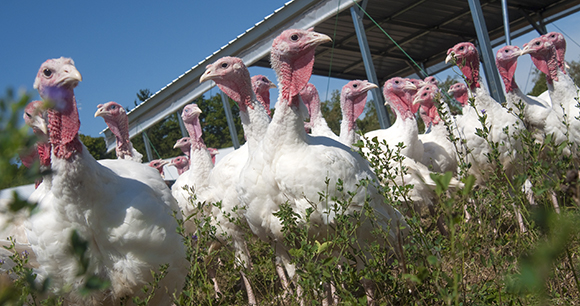
Higher-welfare, pasture-based farms represent a dramatic welfare improvement for turkeys. These farms raise turkeys who mature at a normal rate in modest-sized flocks. Artificial insemination is typically prohibited. Birds on pasture can run, fly, stretch, and flap their wings and have access to forage, dust baths, fresh air, and sunlight. Beak, toe, snood, and other mutilations are usually prohibited.
Finfish
There is no available estimate of the number of finfish reared in farms in the United States. This is due in part to different agencies being responsible for monitoring aquaculture based on whether the farm is in a marine/coastal or inland/freshwater area. A more troublesome reason is that production in the aquaculture sector is reported in tonnage rather than individual animals. The National Oceanic and Atmospheric Administration reported that in 2020, 658 million pounds of marine and freshwater animals were farmed in the United States (including bivalves such as clams and oysters).
Industrial aquaculture production varies significantly depending on the species being farmed; however, the welfare challenges of fish farming largely mirror those associated with the raising of terrestrial farmed animals. The well-being of farmed fish depends in large part on the extent to which they are able to engage in innate behaviors. Fish in industrial aquaculture facilities often live in crowded, barren tanks, pools, or nets, with no mental stimulation or even any opportunity to hide from more aggressive individuals. As with land-based farmed animals, the selective breeding of fish has led to various genetic traits that boost production while compromising welfare. Genetic uniformity and poor immune health in farmed fish has led to rampant disease, parasitic infection, and high mortality.